
Winter Solstice Home Floristry in Melbourne — Dried + Preserved Flowers with Australian Eucalyptus Notes
The southern winter solstice fell on or around 21 June. A week ago. Melburnians do not generally make much of it — no public holiday, no family meal, no florists running solstice-themed window displays. But the body knows. Leaving the house at 6:20 in the morning, the eucalyptus on the corner is still iced. Walking back in at 5:30 in the afternoon, the sky is already gone. The bunch of fresh flowers that has been carrying the living room since three weeks ago is starting to droop and drop petals, and the room sinks a little with it.
These are the two months of the year when it makes sense to switch the logic of how you put flowers in the home. Not for a holiday. Not for anyone else. Not on a seven-to-ten-day rotation. Put down the fresh-flower list that quietly insists you “use me before I die”, and let dried flowers, preserved flowers and a stem or two of eucalyptus slow the house into winter. This article is not a shopping guide. It is about how an ordinary Melbourne home — living room, dining table, entry, bedroom — moves through the weeks between the solstice and early spring.
Living Room: A Bunch You Want to Sit Down Next To
The living room is the most-used room of the winter house. After five-thirty the sofa becomes the gravitational centre of the home — one person, one warm drink, one floor lamp, one book that does not finish itself. The flowers in this space do not need to be bright. What actually works here is volume, texture, and a kind of “it will be here all winter” steadiness.
Dried flowers do this naturally. A generous bunch of pampas grass with deep wheat ears and a few stems of yellow statice, arranged in an opaque ceramic vase or matte-glazed pot, sitting on the side table next to the sofa or beside the floor lamp. The colour palette wants to live in oat, chestnut and warm brown — not festive tones. The vessel matters. Dried flowers do not need water, but in a clear glass vase the bare stems look wrong, like someone forgot to finish the job. A solid, matte ceramic vase holds the weight of the bunch and makes the room look as if someone is genuinely living in it.
For a quieter, more eastern feel, a smaller round ceramic pot on the coffee table opposite the sofa, filled with nothing more than three to five dried eucalyptus stems — Melbourne’s everyday silver dollar eucalyptus or lemon eucalyptus — is enough to carry the whole corner. H Flowers’ dried flowers range (these are not fresh flowers) carries a handful of finished arrangements built around eucalyptus that you can buy directly without sourcing stems yourself.
The advantage of dried flowers in a high-use room is amplified in winter: they do not die while you are away for a week, they do not dehydrate when the heater runs all night, and they do not require carrying a dripping bunch to the kitchen sink every Sunday. They just stay.
Dining Table: A Preserved Arrangement That Lowers the Cost of “Having Friends Over”
The dining table is a different brief. Unlike the living room — where a single arrangement is meant to hold for months — the table comes into focus every time you have friends over, or family sits around, or you cook a careful weeknight dinner for yourself. It needs to turn the table from “the table you eat at” into “the table you sat down at on purpose”.
Fresh flowers for that job, in winter, are neither cheap nor easy. A respectable centrepiece lasts three to seven days, and a high proportion of winter cut-flower stock is imported, which keeps prices firm. Preserved flowers fit this brief better than dried flowers — they retain the form and softness of fresh blooms, with colour close to true roses, hydrangeas and carnations, but they last a year to eighteen months, do not need watering, do not drop petals, and tolerate both heating and cold draughts.
For the table itself: a low rectangular ceramic dish in the centre, filled with preserved hydrangea as the base in pale moss green or soft khaki, two to three preserved roses (off-white or pale dusk pink) as focal flowers, a few sprays of preserved gypsophila and a couple of small eucalyptus stems to lift the green. The whole arrangement should sit below seated eye level — about twenty-five centimetres or less — so the person across the table can meet your eye through, not over, the flowers. Florists call this the golden rule of the dining centrepiece.
H Flowers’ preserved flower range (these are not fresh flowers) includes finished table arrangements for those who would rather not build the composition themselves. The dry flower arrangements collection is another place to find ready-made, year-round options that suit winter use.
Preserved flowers fade gently over time — this is what makes them different from fresh, and ultimately what makes them watchable for so long. A slightly saturated tone on day one will, six months in, settle into something more muted and closer to natural fibre. That slow change has a quiet alignment with the way winter actually moves.
Entry Hall: One Stem of Eucalyptus to Catch You at the Door

The entry hall is one of Melbourne’s most undervalued winter rooms. In the morning it is rushed — scarf, keys, mask, umbrella, thermos, all grabbed at once. In the evening it is tired — wet coat onto the hook, cold hand dropping keys into the bowl, body still carrying outdoor chill. The role of a flower here is not decoration. It is to catch you.
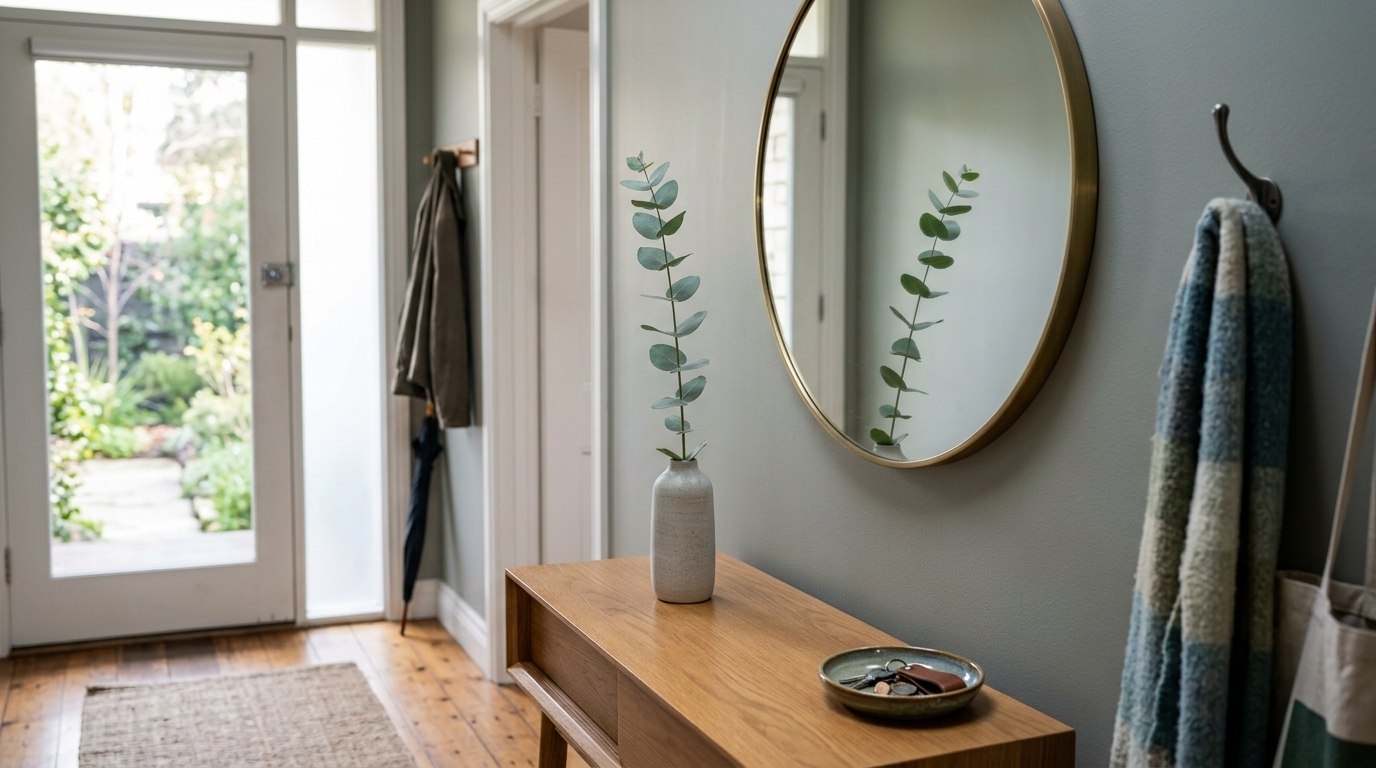
The right thing in this space is a single stem of eucalyptus — formed, characterful, low-maintenance. Of the species available year-round in Melbourne: silver dollar eucalyptus has full round leaves in a frosted grey-green with a cool clean scent, equally good hung from a wall hook or placed in a narrow ceramic vase; willow eucalyptus has long pendant leaves that drape softly, suited to a tall side cabinet where the tips can fall naturally; baby blue eucalyptus has small dense leaves with a slightly stronger scent, perfect in a small vase next to the entry mirror so the reflection multiplies the green when the door opens.
Eucalyptus is the national plant of Australia in everything but title — drive any back road through the Yarra Ranges and it covers the hills. Bringing a single stem of it from the outside into the entry hall is, in effect, bringing in a small piece of Melbourne’s wet, sharp, slightly resinous winter air. That sense of place is something no imported stem can supply.
A good shortcut is to buy a fresh bouquet that has eucalyptus as part of the foliage, then on arrival put the flowers elsewhere and keep just the eucalyptus in the entry. A single fresh eucalyptus stem in water holds two to three weeks; by the time the leaves give up moisture they have already dried in place, and the stem transitions seamlessly into a dried piece you can keep using.
Bedroom: One Restrained Stem, So the Morning Has Light to Itself
The bedroom asks for different logic again. A Melbourne morning in July or August at seven o’clock is still grey-blue; the window is sometimes wet, sometimes fogged. The last thing the bedside needs at that hour is visual noise — anything saturated, bulky or heavily coloured on the bedside table will make an already difficult morning harder.
What works here is one stem. A single preserved rose in cream or pale dusk grey, a small dried lavender bundle, or one or two quiet gypsophila sprays. The vessel is the smallest opaque vase in the house — white porcelain, matte cream ceramic, dark glazed stoneware — no taller than fifteen centimetres. On the corner of the bedside table, not blocking the lamp, not stealing colour, not in the way of the half-asleep arm reaching for the alarm.
This kind of restraint — one stem, nothing else — is the core of winter bedroom floristry. Give the light, the space and the quiet back to the morning. The flower here is not decoration; it is the small signal that you are willing to wake up.
If you want to go quieter still, leave a small handful of dried lavender on a shallow dish next to the bed, no vessel at all, as the room’s sole scent source. That is a complete winter scheme.
Maintenance: Dried and Preserved Are Not Zero-Care, but Close
Many people read “dried” and “preserved” as “you can ignore them”. That is not quite right. They do not need water or trimming, but three small habits keep them looking good far longer.
Light. Direct sunlight will fade any dried or preserved flower noticeably within two to three months, especially in the pink, purple and deep red families. Living rooms, dining tables and entry halls are usually fine; a west-facing windowsill is not.
Damp. Melbourne indoor humidity can spike above seventy per cent through winter, and dried stems dislike this — leaf tips darken and petals soften. If one corner of the home is visibly damp, move the arrangement; homes that run heating or a dehumidifier through winter rarely have a problem.
Dust. Every two to three weeks, the lowest cool setting on a hairdryer, held a comfortable distance away, will lift dust off without disturbing the form. Avoid wet cloths — dried flowers do not come back from water.
Following those three, a good dried bunch holds the whole winter, and a well-made preserved arrangement holds a year to eighteen months.
Turning Winter Into Two Months You Want to Be Inside For
The rhythm of fresh flowers belongs to spring and summer — quick changes, high notes, every bunch its own small event. Winter is not that. Winter suits things that are willing to stay — a pampas bunch that has lived in a ceramic vase for three months, a preserved table arrangement that has not moved in half a year, a single eucalyptus stem slowly drying its way from the entry into the living room.
Those things sit quietly with you through July and August — the two coldest, darkest, most-likely-to-stay-on-the-couch months of the year. When the first peonies and daffodils reappear at Melbourne corner shops in September, you will find you did not actually miss winter. It was the ceramic vase in the living room, the whole time.
H Flowers’ Box Hill store and the online dried and preserved flower ranges keep seasonally appropriate pieces available year-round; the Melbourne flower delivery page handles local delivery for homes that prefer to order online.
All dried and preserved arrangements referenced in this article are not fresh flowers. Colour palettes and stem combinations vary slightly with seasonal supply; for current availability, refer to the H Flowers website.
Read more
Melbourne B2B New Financial Year Flowers — The Composed Opening of a Single Bouquet
There is a particular kind of quiet that settles over Melbourne offices in the first week of July. The books closed at the end of June, without festoons or coloured lights; and now a clean page is ...
Read more
July in Melbourne is deep winter — a thin mist on the morning windows, the coldest weeks of the year — yet the florists on the corner are already preparing for the busy season that follows. In a li...
Read more