
Send Flowers Melbourne in Winter: Thoughtful Reasons Why
When to Send Flowers Without an Occasion — A Melbourne Guide to Winter Thoughtfulness
1. The Quiet Months Between Mother's Day and Christmas
Mother's Day falls on the second Sunday of May. After that, Melbourne's floral calendar goes quiet. There is no traditional gift-giving peak between mid-May and December — no Valentine's Day, no Mother's Day, no Christmas. For roughly seven months, sending flowers stops being a default cultural script and starts being a choice.
That gap matters more than it sounds. These are the months when Melbourne tips into real winter — sun setting before 5 pm, social calendars thinning out, the long stretch of grey weeks between EOFY paperwork and the year-end break. It is, statistically and emotionally, when people feel most overlooked. And it is the exact window when a small, unexpected bouquet lands the hardest.
Local florists notice a pattern in this period: the share of orders where the sender writes a personal note climbs significantly compared with February or December. People are no longer sending flowers to complete a ritual. They are sending them because they actually want to say something. The bouquets get smaller, the cards get more specific, and the reasons get more personal.
The problem is rarely the flowers. It is finding a reason — or rather, finding permission to send without one. Cultural scripts make flowers feel appropriate on the second Sunday of May and awkward on the third Wednesday of July, even when the third Wednesday of July is when the recipient could most use them. Below are five quiet, unscripted moments when sending flowers in Melbourne winter makes more sense than people give themselves credit for.
2. Sympathy and Get-Well — When Words Feel Too Heavy
There is a kind of message that does not write itself easily: someone is recovering from surgery, an elderly parent has been admitted to hospital, a friend has had a hard week of treatment. Cards feel inadequate. Long messages feel intrusive. Flowers, chosen well, fill the gap.
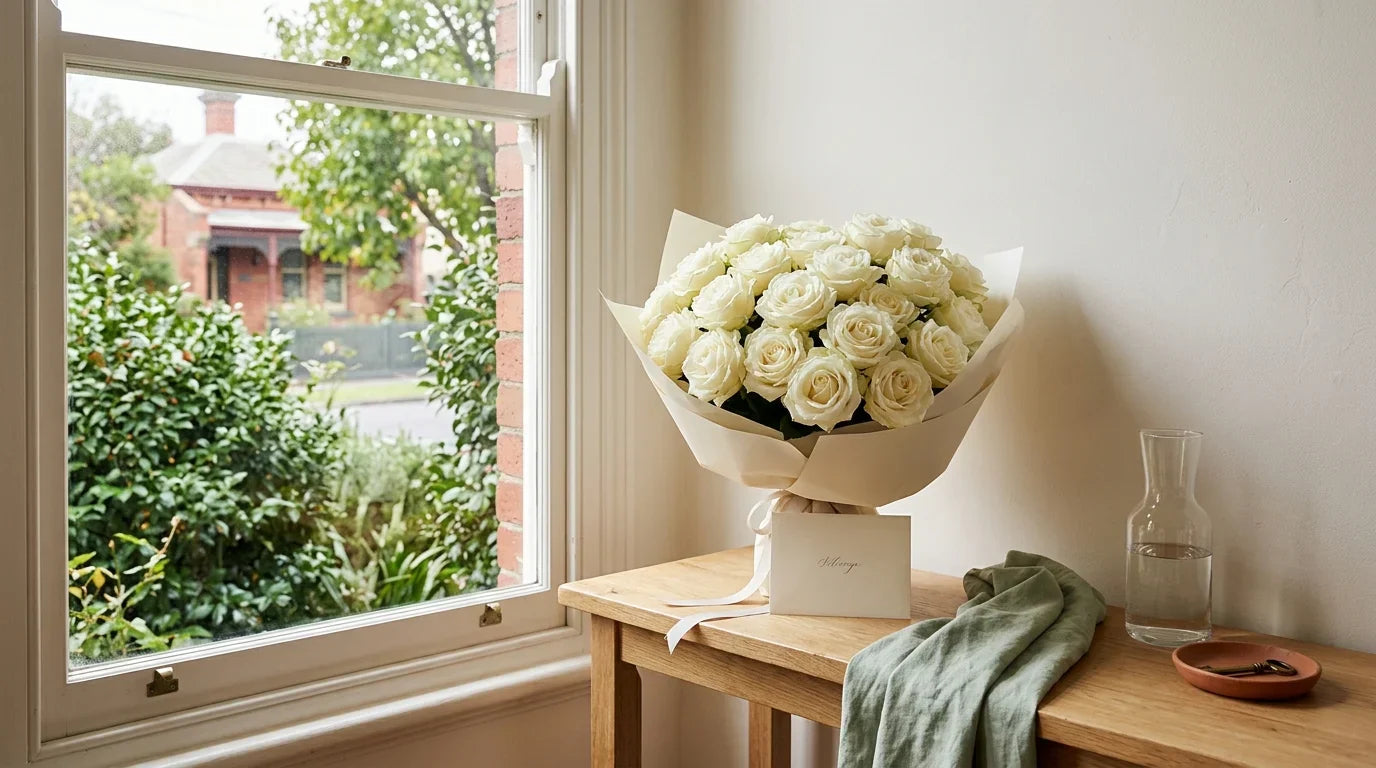
The choices that matter here are restraint and softness. Hospital and recovery environments are sensitive to strong fragrance, so heavily perfumed varieties are best avoided. Colour palette leans toward gentle whites, soft pinks, pale lilacs and dusted creams. A bouquet of white roses paired with lisianthus and eucalyptus tends to read as elegant without feeling clinical or sombre.
For sympathy specifically — bereavement, condolence, a difficult anniversary — Australian convention sits closer to whites and pale blues than to bright reds or yellows. The visual language is "I am here, quietly" rather than celebratory. Arrangements in muted cream and dusty blue palettes, or soft champagne neutrals, suit the tone.
A small note on the card: skip the functional phrasing. "Get well soon" reads like a vending-machine message. "Thinking of you this week" is closer to how people actually want to be addressed when they are unwell. Fifteen words or fewer, in the sender's own voice, lands harder than a long paragraph.
3. Corporate Thank-You — EOFY Is Quietly the Best Window
The end of the financial year is a strange threshold. Paperwork is wrapping up, teams are exhausted, and the calendar offers no built-in moment to say thank you. For businesses, this is precisely why late June and early July work so well for a considered gesture toward clients, staff, or long-term suppliers. The market is not saturated. A bouquet arriving in this window stands out simply because nobody else is sending one.
Two common mistakes flatten corporate flower gifts. The first is being too formal — bouquets accompanied by stiff phrases like "wishing your esteemed company continued success" feel templated and impersonal. The second is being too casual — using a first name only on the card when the relationship has always been professional. The middle path works best: a measured, third-person tone with the recipient's surname, or simply the company name. The card does the work of signalling care without overreaching the relationship.
Useful corporate scenarios where flowers land well include: thanking long-standing clients at year-end, marking a new team member's first month, acknowledging a supplier who has handled something difficult, and remembering interstate partners who do not often get a face-to-face thank you.
Boxed flowers fit corporate settings better than wrapped bouquets. They arrive ready to display, require no vase-hunting, and sit comfortably on a desk or reception counter for five to seven days. On colour, it is worth pulling back from the heavy reds — they carry strong emotional associations that can feel awkward in a professional context. Cooler, more architectural palettes — whites and greens, or deep contrasting tones — read as considered rather than romantic.
4. Milestones Without a Card Aisle — New Job, Moving House, First Apartment
Hallmark does not make cards for the moments that happen most often in actual life. There is no aisle for "you just signed a lease," no section for "first month at the new job," no shelf labelled "you finally moved out." And yet these are the moments where a small floral gesture lands with surprising weight.
A few practical observations for each:
New job, first week. Resist the urge to send a large bouquet. Walking into a new workplace under a wave of cellophane attracts the wrong kind of attention from new colleagues. A compact boxed arrangement that fits on a desk gets the warmth across without making the recipient feel watched.
Moving house. The intuitive timing — sending flowers on moving day — is actually the worst. The house is in boxes, there are no vases unpacked, the kitchen sink is full. The better play is to wait until roughly the second week, when the place has begun to settle. That is when a bouquet stops being one more thing to manage and starts being the first piece of decoration in the new space.
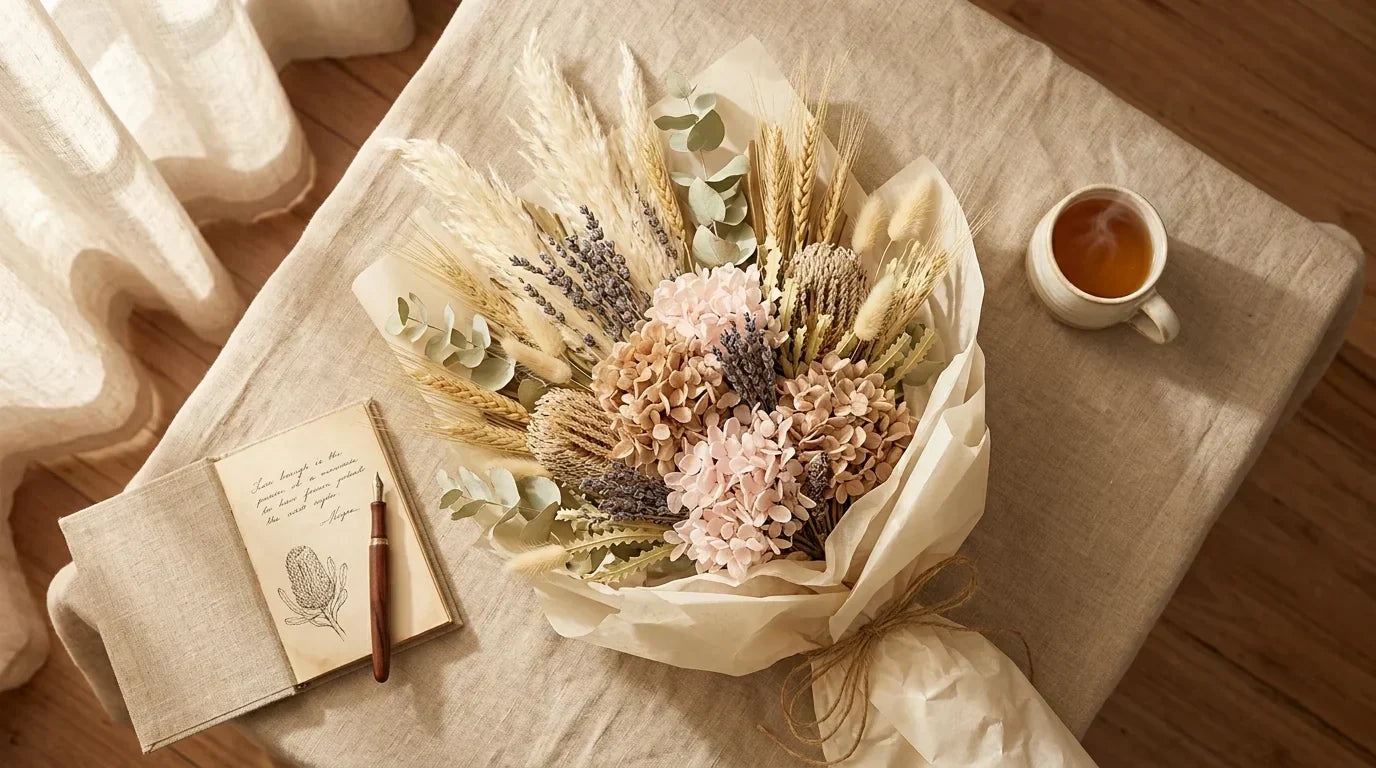
First apartment, first home. The gift here is not really the flowers — it is the signal that this new space is worth a ritual. Preserved or dried arrangements work especially well for this milestone. They do not require vase-changing or water-top-ups during the first chaotic month, and they last long enough to anchor the room while the owner figures out the rest of their style.
Preserved and dried flowers double as a long-form gesture in general: they keep the memory of the moment visible for a year or more, rather than fading by the weekend.
5. The "I Was Thinking of You" Send — No Reason at All
The hardest send, and the one that lands with the most force, is the one with no occasion attached.
Florists notice that the cards on these orders tend to be the shortest. "Just because." "Saw these and thought of you." "Wanted you to know I'm here." There is no anniversary, no birthday, no diagnosis. Which is exactly what makes them register — the recipient cannot file the flowers under an obligation. They have to file them under "this person was thinking about me."
Worth sending to: parents who live interstate (New South Wales, Queensland, or further), a friend who has just come out of a hard breakup, a colleague who has gone quieter than usual in the last month, a sibling who never quite gets remembered between birthdays.
On colour, the rule shifts. There is no event dictating the palette, so the choice should follow the recipient's actual taste, not a generic scheme. Someone who lives in minimalist whites and woods will be best served by a monochrome cream arrangement. Someone whose home is full of colour and texture will respond to a mixed-bright bouquet far better than to muted neutrals.
On timing, midweek delivery — Tuesday or Wednesday — carries more weight than weekend. Weekend flowers blend into the general flow of social plans, family visits, and brunch tables. A bouquet arriving on a Wednesday afternoon, when the recipient is mid-grind between meetings or halfway through a tired commute home, has an entirely different emotional register. It reads as deliberate. It also lands in a quieter inbox of life — there is less competing for attention, so the gesture itself does more of the talking.
Closing
The hardest part of sending flowers is rarely the flowers themselves. It is finding a reason that feels permissible. In a city where the formal floral calendar goes quiet between Mother's Day and Christmas, the most useful thing to remember is that none of these five moments needs a Hallmark holiday to justify itself. A short note, the right colour, a midweek delivery — and the rest, the flowers handle on their own.
H Flowers delivers across Melbourne and Box Hill, with same-day delivery available on weekday orders. Browse this season's best sellers to start.
Read more
Dried Flowers: Melbourne's Quietest Winter Luxury
Once winter properly arrives in Melbourne, the cut roses on your dining table tend to start drooping by day five.You change the water. You add a sugar cube. You snip the stems again and again. None...
阅读更多
Melbourne B2B New Financial Year Flowers — The Composed Opening of a Single Bouquet
There is a particular kind of quiet that settles over Melbourne offices in the first week of July. The books closed at the end of June, without festoons or coloured lights; and now a clean page is ...
阅读更多